

- Separate carriers. General liability from one insurer and workers’ compensation from another, on separate certificates.
- Early renewals. Next year’s certificate arrives before this year’s policy ends.
Which policy each coverage is judged on
For each coverage type, across every certificate in force:- The policy in force today wins. Its limits and endorsements are the ones checked. If two policies for the same coverage are in force today, the one that ends later is used.
- If none is in force today, the one that starts soonest is used, and reported as not yet in force.
- If every policy has ended, the one that lapsed most recently is used, and reported as expired.
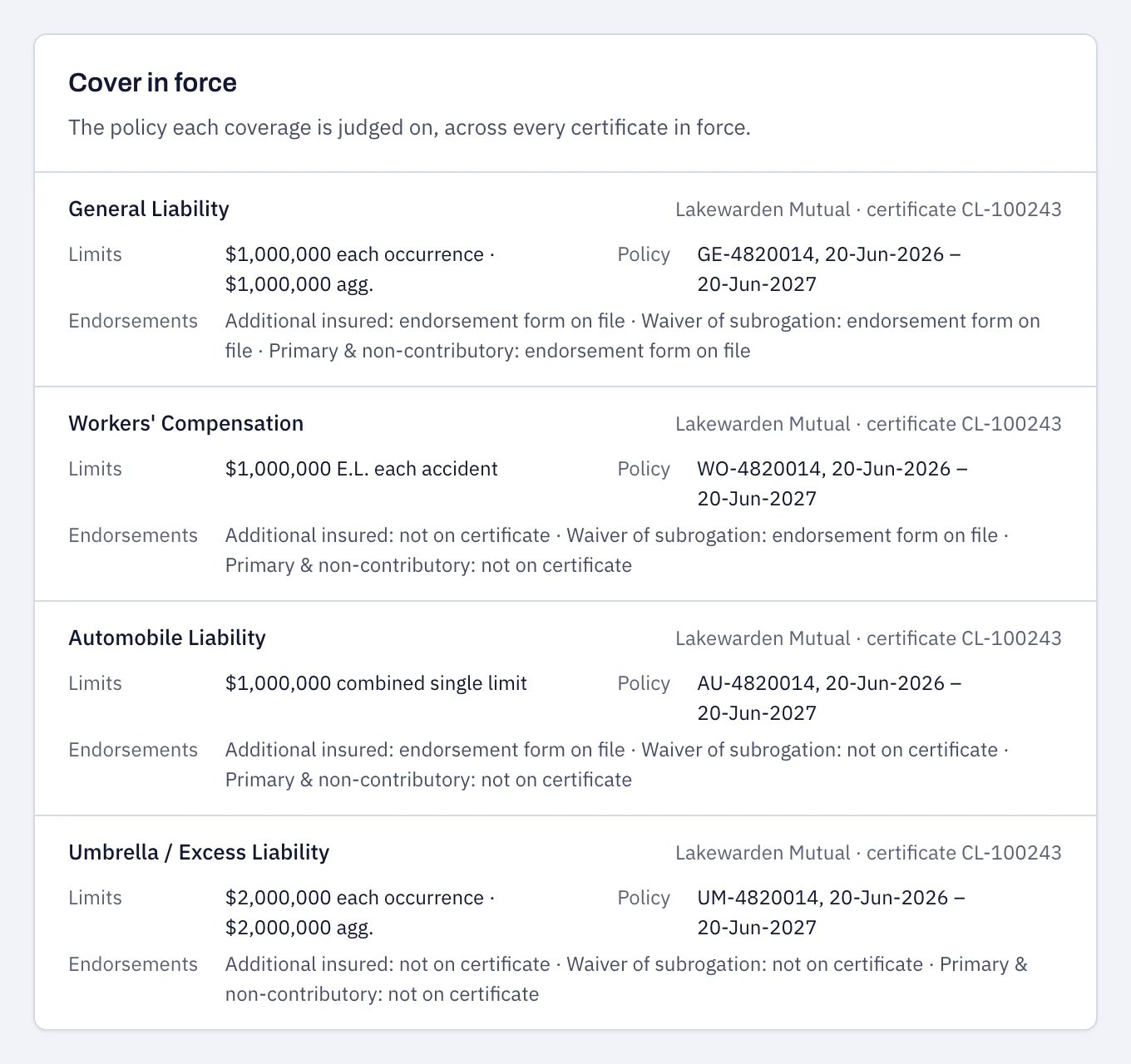
Cover in force: the policy each coverage is being judged on.
Renewals carry cover forward
If a renewal on file starts on or before the day the current policy ends, the cover is treated as unbroken. The expiry date that matters, for the Expiring soon warning, for chasing and for sorting the register, becomes the end of the renewal. So recording a renewal early:- clears the Expiring soon status straight away. Only the renewal’s dates are used for this; whether it meets the requirements is judged when it takes effect;
- withdraws any renewal chase still queued for the old expiry date, so the subcontractor is not asked for something you already have;
- does not change today’s verdict on limits and endorsements, which still come from the policy in force today. The renewal’s own limits and endorsements are judged the day it takes effect.
If the renewal starts after the old policy ends, there is a gap. The renewal ladder runs on the old expiry up to its final notice. From the expiry date, the coverage is Non-compliant as not yet in force until the renewal takes effect, and that gap is chased once, straight away.
When an old certificate is set aside
A new certificate replaces an older one only when it fully takes its place today: every coverage on the old certificate is on the new one, and each old coverage has either already lapsed or is replaced by a new policy that is already in force and runs at least as long. The old certificate is then marked superseded. A certificate whose policy ends sooner than the one on file, such as last year’s filed late, never sets the newer one aside.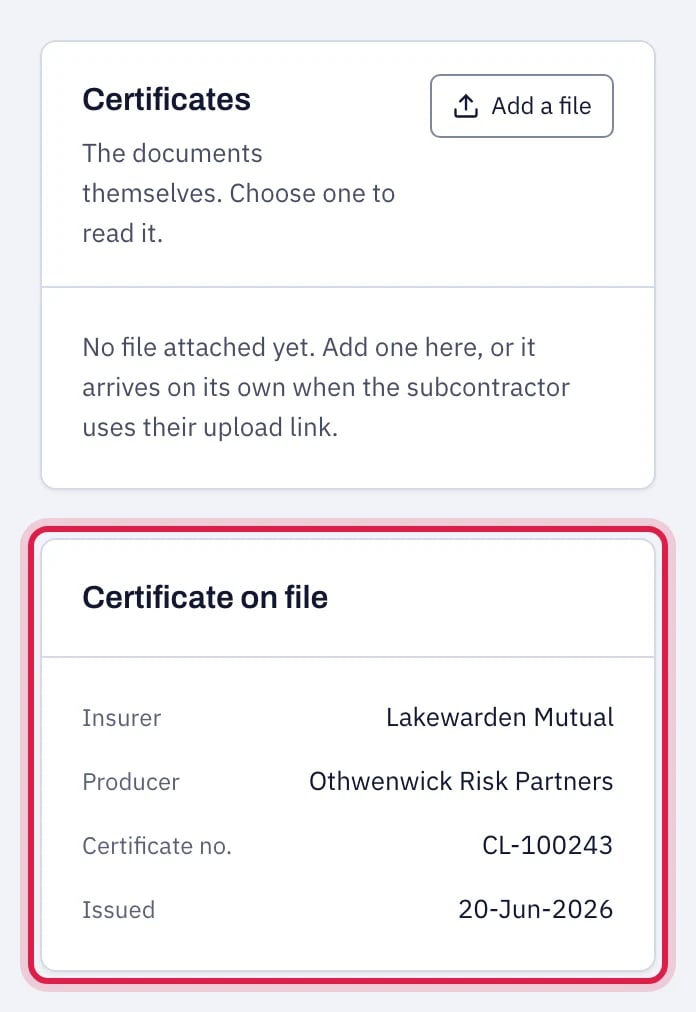
Certificate on file lists each certificate still in force.